
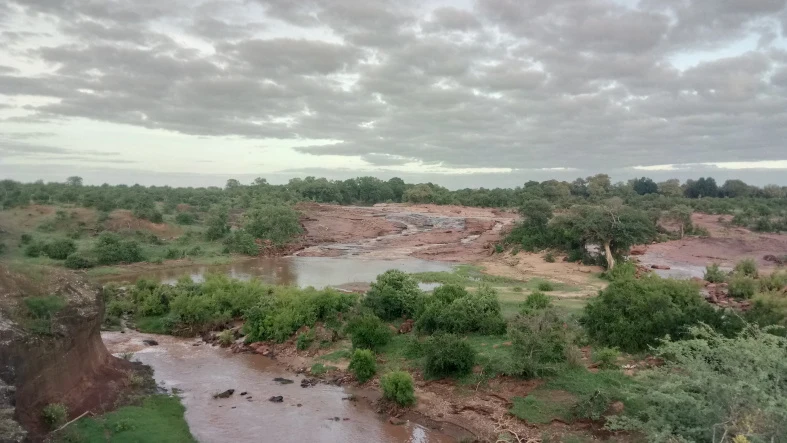
A river view offers several scales at once. There is the immediate bank, the channel or exposed sand, a line of vegetation and the country beyond. Looking across these layers is a useful way to slow down without expecting a particular animal to appear.
Kruger’s rivers belong to different parts of the park. A photograph of the Crocodile River does not stand in for Letaba, and a scene at Red Rocks is not a promise about the water level during your visit. Keep the actual place and season alongside the image.
The same corridor can change
The paired research photographs below show woodland and thorn thickets west of Crocodile Bridge in dry and wet conditions. Delabye and coauthors published them as habitat examples in a 2022 research paper. They give a useful visual comparison; they do not establish current flow, access or visitor conditions.
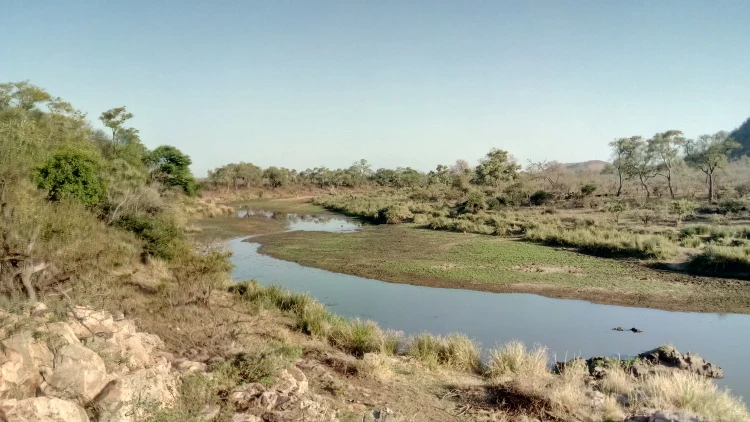
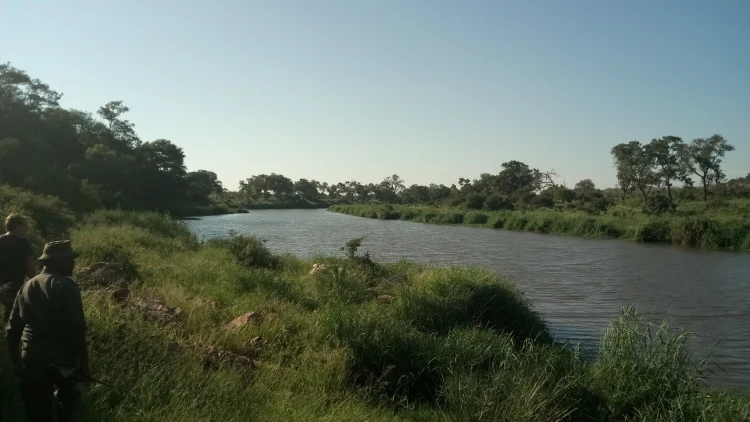
Compare the amount of exposed ground, the appearance of vegetation and the relationship between water and bank. These observations are more defensible than describing one season as universally better. Different visitors value different conditions, and the timing and amount of rain vary.
Use a named place
Letaba Rest Camp sits on a bend of the Letaba River. SANParks describes the camp as riverine within a surrounding mopane landscape. That distinction between a waterside setting and the wider vegetation is useful when choosing a base or reading an itinerary.
Before driving toward a river stop, identify the exact viewpoint, hide or camp on the official map and check that it is open and appropriate for your visit. A river visible from a road is not automatically a place where you may get out. Research access shown in a photograph is also different from ordinary visitor access.
Make room to observe
If you are at a designated place where stopping is allowed, give the scene a few minutes. Watch how shadows define the bank. Notice whether birds are moving between exposed sand and trees. Keep an identification uncertain when the view is too distant; an honest note is more useful than a confident guess.
A quiet river stop need not become a long detour. Build it into a route that still leaves time to return within the current gate or camp requirements. Continue to camp planning or the broader habitat guide.
Sources: Delabye and coauthors,2022, habitat photographs; SANParks Letaba account; official park rules.